As an English speaker living in Buenos Aires, I feel like a post entirely devoted to the language is desperately needed.
Because of Argentina's insistence on being unique, their language is also unique to every other Latino country. For one, Argentines speak castellano, not español even though the language is, in the bigger schemes of things, essentially the same. Now this is not completely an Argentine phenomenon since Spaniards also speak castellano (cah-stay-ya-no) and many capital cities in Latin America also follow suit. However, just to make sure that Argentina isn't lumped into a category with these other exceptions, Argentines change the pronunciation of castellano (cah-stay-sha-no) to differentiate.
In fact, Argentines pronounce everything with a "ll" or a "y" as "sh." This means that "calle" or street is (cah-shay) and "ayuda" or help is (ah-shoo-duh). This can be problematic. For example, it took me an hour to realize that my friend was talking about a pier, "muelle."
But the Argentines don't stop at phonetics; even the vocabulary is different. To name a few: "niño"is "nene," "piña" is "ananá," "hombre" is "barón," and "manteca" is "mantequilla." The list goes on and on. And why not add a word with no real meaning at all? Argentines love to throw a "che" in just for good measure. What it means exactly, not even the most Argentine of Argentines will be able to tell you, but, "che," it sounds great.
And if you thought verbs were safe, you thought wrong. Argentines like the conjugation "vos" rather than the "tú" you learned in high school Spanish. Want to tell someone to come here? The standard "ven" or the more formal "venga" just won't do. "Vení" is more like it.
And then, if all of that is not enough, don't forget the quirks. Argentines have a nasty habit of changing the order of the letters in a word. Don't be surprised if an Argentine orders a "feca" instead of a "café" at a coffee shop.
All this to say that as a semi-fluent (if such a thing exists) Spanish speaker, it is a little disheartening to arrive in Buenos Aires to find that the people speak a language quite different than the one you have studied in your three years at the university. It can be even more frustrating when you start speaking like them yourself.
Argentina is defined in a lot of ways by what it is not, but I'm more interested in what it is. It's true; Argentina is not like everyone else, but it is like Argentina. The quirky language, the Boca-River rivalry, the breakfast medialunas, the daily demonstrations, the public transportation (Bondi or Subte), the national color of celeste--this is Argentina. This is what I have come to know and love about this wonderful country.
Instead of getting caught up in who we are not, we can hold on to who we are--children of God.
Rambles
Monday, July 25, 2016
Saturday, July 2, 2016
Where are you from?
Everyone in our barrio knows who we are, and more importantly, that we are not from here. No matter where we go, as soon as we open our mouths, someone is bound to ask us the dreaded question, "where are you from?" For example, an average conversation at the fruiteria might go something like this (in Spanish, of course):
Me: "Hi, I would like four red apples and four bananas."
Owner: "Ok, where are you from?"
This used to irritate me to no end, especially when I thought my pronunciation was spot on. No matter how hard I tried to sound like an Argentine, people stared at me like I was from Mars. One time, after the third person that day asked me where I was from, I had had enough. The object of my frustration was an innocent barista at a coffee shop. Exasperated, I asked him what gave me away. The answer? He said, "you just sound different."
At first I was a little put off. I thought, how can I not sound different? Then I realized, maybe I will always sound different because I am different, just a little anyway, and it's not necessarily a bad thing.
Yes, the guy at the bakery knows that we are from the United States, but he remembers our order before we even get to the counter. Yes, the cashier at the market greets us in English, but he never fails to speak to us. And yes, the man at the fruiteria thinks we sound different, but he gives us free pears.
The truth is, because we are different, we have made friends. Most of the conversations we have had are because someone has asked us where we are from. The woman at the bookstore and the waiter at the pizza place are two examples of people that have spoken to us because our deficiencies in Spanish have given us away.
Before coming here, I prided myself on my ability to speak Spanish. In my classes at the university, I excelled. Unfortunately, everything I've studied could not have prepared me for Argentina. The accent is different, the intonation, the conjugations of the verbs, even the name of the language (Spanish is called Castellano in Argentina). Most of the time I sound like an eight-year-old.
But this trip is not about me showing off my Spanish fluency. In fact, this trip isn't about me at all. This trip is about using my differences and deficiencies to point everyone around me to someone much greater than me. The free fruit is a bonus.
Me: "Hi, I would like four red apples and four bananas."
Owner: "Ok, where are you from?"
This used to irritate me to no end, especially when I thought my pronunciation was spot on. No matter how hard I tried to sound like an Argentine, people stared at me like I was from Mars. One time, after the third person that day asked me where I was from, I had had enough. The object of my frustration was an innocent barista at a coffee shop. Exasperated, I asked him what gave me away. The answer? He said, "you just sound different."
At first I was a little put off. I thought, how can I not sound different? Then I realized, maybe I will always sound different because I am different, just a little anyway, and it's not necessarily a bad thing.
Yes, the guy at the bakery knows that we are from the United States, but he remembers our order before we even get to the counter. Yes, the cashier at the market greets us in English, but he never fails to speak to us. And yes, the man at the fruiteria thinks we sound different, but he gives us free pears.
The truth is, because we are different, we have made friends. Most of the conversations we have had are because someone has asked us where we are from. The woman at the bookstore and the waiter at the pizza place are two examples of people that have spoken to us because our deficiencies in Spanish have given us away.
Before coming here, I prided myself on my ability to speak Spanish. In my classes at the university, I excelled. Unfortunately, everything I've studied could not have prepared me for Argentina. The accent is different, the intonation, the conjugations of the verbs, even the name of the language (Spanish is called Castellano in Argentina). Most of the time I sound like an eight-year-old.
But this trip is not about me showing off my Spanish fluency. In fact, this trip isn't about me at all. This trip is about using my differences and deficiencies to point everyone around me to someone much greater than me. The free fruit is a bonus.
Saturday, June 25, 2016
Futbol Fanatics
I've only been in Buenos Aires for a month, but already I have caught the futbol fever that is ravaging through the Americas. Some United States citizens don't even know about Copa America that is taking place in their own backyard, but, I assure you, all of Argentina is on the edge of their seats, myself included.
A few weeks ago, I had the great honor of watching my first futbol match: Argentina v. Venezuela. I even had my very own commentator, an Argentine with a lot of patience. I asked far too many questions, but I wanted to know about this new world of soccer. More importantly, I wanted to know why the fans were so crazy about the sport.
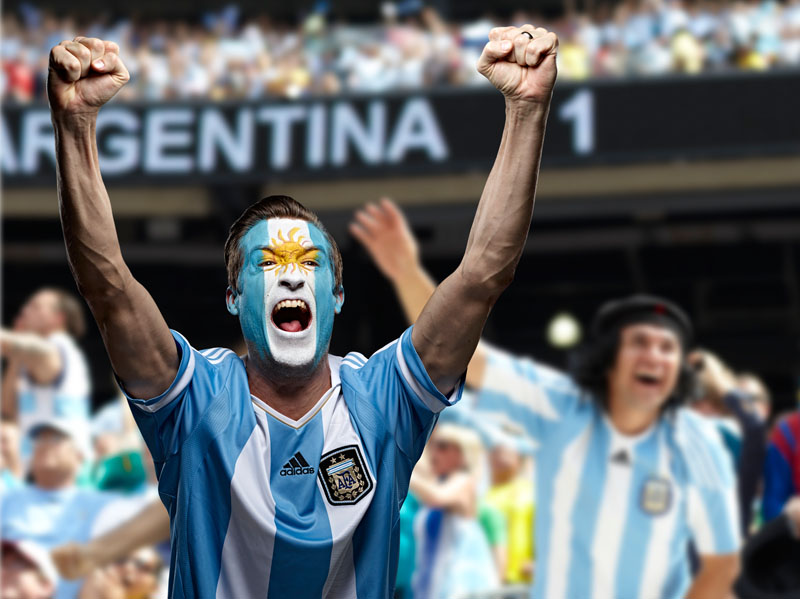
Fans is too mild of a word. A better one is "fanaticos" or fanatics, also known in Latin America as "hinchas." These people don't like futbol, they worship it, especially the fans of the Argentine selection team. The crowd, decked out in their "celeste" or sky blue is a part of the game itself.
But fans aren't just found in the stadium; some of the most die-hard fanatics are found sitting on a sofa in front of the their own television. When watching the game, it is not unusual to hear all your neighbors within hearing distance simultaneously cheering when a goal is made. In the case of the Argentina v. Venezuela match, Argentines had plenty of chances to cheer.
The score ended up being 4-1, Argentina. The great hero of the night was none other than Lionel Messi, arguably one of the best futbol players of all time. Messi has a crowd of worshippers all his own. All his followers were especially devoted to him last weekend during the match against U.S.A. in which Argentina won 4-0. One of these goals was made during an impressive penalty kick by Messi. As little as I know about soccer, I knew there was something nearly miraculous about the kick that sent the ball in to the right corner of the goal just out of the goalie's reach.
I cannot help but hope that this same kind of fever for futbol and Messi will grip the nation in the form of love for the Gospel and for Christ. Imagine what would happen if we were fanatics for our faith. It would change the game of the world forever.
All of the soccer enthusiasts will be watching the match against Chile this Sunday for the finals. Of course, I will be watching as well and cheering for the team that made me fall in love with the sport. Futbol games, however, will end after two forty-five minute halves, and the glory of a win fades eventually. Our lives on the other hand, are longer, and the glory of being a fan of the Gospel will never fade.
A few weeks ago, I had the great honor of watching my first futbol match: Argentina v. Venezuela. I even had my very own commentator, an Argentine with a lot of patience. I asked far too many questions, but I wanted to know about this new world of soccer. More importantly, I wanted to know why the fans were so crazy about the sport.
Fans is too mild of a word. A better one is "fanaticos" or fanatics, also known in Latin America as "hinchas." These people don't like futbol, they worship it, especially the fans of the Argentine selection team. The crowd, decked out in their "celeste" or sky blue is a part of the game itself.
But fans aren't just found in the stadium; some of the most die-hard fanatics are found sitting on a sofa in front of the their own television. When watching the game, it is not unusual to hear all your neighbors within hearing distance simultaneously cheering when a goal is made. In the case of the Argentina v. Venezuela match, Argentines had plenty of chances to cheer.
The score ended up being 4-1, Argentina. The great hero of the night was none other than Lionel Messi, arguably one of the best futbol players of all time. Messi has a crowd of worshippers all his own. All his followers were especially devoted to him last weekend during the match against U.S.A. in which Argentina won 4-0. One of these goals was made during an impressive penalty kick by Messi. As little as I know about soccer, I knew there was something nearly miraculous about the kick that sent the ball in to the right corner of the goal just out of the goalie's reach.
I cannot help but hope that this same kind of fever for futbol and Messi will grip the nation in the form of love for the Gospel and for Christ. Imagine what would happen if we were fanatics for our faith. It would change the game of the world forever.
All of the soccer enthusiasts will be watching the match against Chile this Sunday for the finals. Of course, I will be watching as well and cheering for the team that made me fall in love with the sport. Futbol games, however, will end after two forty-five minute halves, and the glory of a win fades eventually. Our lives on the other hand, are longer, and the glory of being a fan of the Gospel will never fade.
Friday, June 17, 2016
Passion of the Plaza
I wasn't prepared to see the Plaza de Mayo. My teammate and I with one of our new friends decided to casually stroll through the area on our way to visit Puerto Madero; however, our friend was, as many Argentines are, late, and we were left to wander around the plaza. Before long, the history had absorbed us.
The Plaza de Mayo is situated right in front of the Casa Rosada (the Pink House) where the President works. In the heart of the plaza is a statue commemorating the revolution for independence on May 25, 1810. Since that date, the plaza has been the literal political arena of Argentina.
The Plaza de Mayo was the site for the protests that ended in the release of Juan Peron who later became president as well as the beginning of what would become the Falkland Wars. But the most intriguing to me is that this very spot is where the Mothers of the Plaza de Mayo gathered in the 1970s. The group is made up of women with children or grandchildren, called "desaparecidos" or disappeared, who were presumably killed by the government during the Dirty War. The Mothers wear the symbolic white handkerchiefs on their heads to symbolize peace, and hold up signs with photographs of the missing.
But the Plaza de Mayo is not something of the past. Manifestations and demonstrations are held daily. When we visited, there was a group protesting the public school system. The roads were barricaded, drums were being beaten, and people were marching with signs in tow. In fact, the Plaza is also a place where the past and the present meet. Every Thursday the same Mothers of those disappeared in the Dirty War march on the cobblestones of the plaza which are now painted with the symbol of the white handkerchief.
What seemed a bit bizarre to us, is normal here in Argentina. Protesting is simply the way that people express themselves. When Argentines are loyal to things, they tend to be more loyal than the rest of us. Whether that's to their country, a futbol team, or a political belief. My prayer is that Argentines will have that same fierce passion for God, and maybe we could learn a lesson from them ourselves.
The Plaza de Mayo is situated right in front of the Casa Rosada (the Pink House) where the President works. In the heart of the plaza is a statue commemorating the revolution for independence on May 25, 1810. Since that date, the plaza has been the literal political arena of Argentina.
The Plaza de Mayo was the site for the protests that ended in the release of Juan Peron who later became president as well as the beginning of what would become the Falkland Wars. But the most intriguing to me is that this very spot is where the Mothers of the Plaza de Mayo gathered in the 1970s. The group is made up of women with children or grandchildren, called "desaparecidos" or disappeared, who were presumably killed by the government during the Dirty War. The Mothers wear the symbolic white handkerchiefs on their heads to symbolize peace, and hold up signs with photographs of the missing.
But the Plaza de Mayo is not something of the past. Manifestations and demonstrations are held daily. When we visited, there was a group protesting the public school system. The roads were barricaded, drums were being beaten, and people were marching with signs in tow. In fact, the Plaza is also a place where the past and the present meet. Every Thursday the same Mothers of those disappeared in the Dirty War march on the cobblestones of the plaza which are now painted with the symbol of the white handkerchief.
What seemed a bit bizarre to us, is normal here in Argentina. Protesting is simply the way that people express themselves. When Argentines are loyal to things, they tend to be more loyal than the rest of us. Whether that's to their country, a futbol team, or a political belief. My prayer is that Argentines will have that same fierce passion for God, and maybe we could learn a lesson from them ourselves.
Saturday, June 11, 2016
From the Comunas to the Villas
Argentina is a city of immigrants. Of course it all began with Spanish colonization in the 1500s, but what many people do not realize is that there was a huge wave of immigration from Europe in the 19th century. A large percent of people in this era arrived from Italy; however, there is a sizable number of Jews and Germans that sought refuge in Argentina before and after World War II. In fact, Argentina has the largest Jewish population in all of Latin America. Lately, immigration has still been relatively steady with most of the influx coming from Bolivia, Peru, and other Latin American countries as well as Asia. Because of these waves of immigration, Argentina has the second largest population of immigrants behind the United States. Now where do all of these immigrants settle? None other than the port city of Buenos Aires, of course.
All this to say, Buenos Aires is home to a wide variety of people. It is because of this diversity, that I, thankfully, do not stand out, at least at first glance. If someone were to see me sitting on the bus(keeping my mouth shut) I would pass quite easily for a Porteño.
Buenos Aires, however, is not necessarily a melting pot. Each immigrant has brought an ingredient to the table that has retained its unique flavor. This uniqueness is obvious in the very geography of the city. Buenos Aires is made up of fourteen different "comunas" or neighborhoods. Each comuna has a different flavor of sorts, and these past few weeks I have had the honor of taste testing each of them.
I have nearly seen it all, from tangoes in the vibrant comuna of La Boca to an orchestra concert in the distinguished comuna of Palermo. However, the place that has awed me the most does not belong to either of these. In fact, it is does not belong to a comuna at all. On the outskirts of the city, immigrants have "squatted" and built their own houses with whatever materials are available. This is called a "villa" or a slum.
Villas aren't even given names because they aren't recognized as neighborhoods. Instead, they are given numbers. I had the opportunity to not only see but walk up and down the muddy avenues of a villa called Villa Veinte or Slum Twenty. Stepping over dogs and people and rubble, I made my way into another world.
I may forget the color of the dress of the tango dancer in La Boca and what the orchestra played in Palermo, but I will never forget the faces of the people of Villa Veinte. I don't think you can ever forget something like that, and I don't think we should. My visit to the villa reminded me of how wealthy I am, not just in the financial sense, but the spiritual as well. I have more to offer these people than just money. I have Christ who is worth more than all the riches in the world.
All this to say, Buenos Aires is home to a wide variety of people. It is because of this diversity, that I, thankfully, do not stand out, at least at first glance. If someone were to see me sitting on the bus(keeping my mouth shut) I would pass quite easily for a Porteño.
Buenos Aires, however, is not necessarily a melting pot. Each immigrant has brought an ingredient to the table that has retained its unique flavor. This uniqueness is obvious in the very geography of the city. Buenos Aires is made up of fourteen different "comunas" or neighborhoods. Each comuna has a different flavor of sorts, and these past few weeks I have had the honor of taste testing each of them.
I have nearly seen it all, from tangoes in the vibrant comuna of La Boca to an orchestra concert in the distinguished comuna of Palermo. However, the place that has awed me the most does not belong to either of these. In fact, it is does not belong to a comuna at all. On the outskirts of the city, immigrants have "squatted" and built their own houses with whatever materials are available. This is called a "villa" or a slum.
Villas aren't even given names because they aren't recognized as neighborhoods. Instead, they are given numbers. I had the opportunity to not only see but walk up and down the muddy avenues of a villa called Villa Veinte or Slum Twenty. Stepping over dogs and people and rubble, I made my way into another world.
I may forget the color of the dress of the tango dancer in La Boca and what the orchestra played in Palermo, but I will never forget the faces of the people of Villa Veinte. I don't think you can ever forget something like that, and I don't think we should. My visit to the villa reminded me of how wealthy I am, not just in the financial sense, but the spiritual as well. I have more to offer these people than just money. I have Christ who is worth more than all the riches in the world.
Thursday, June 2, 2016
Adventures in Mate
It has only been a week since I arrived in Buenos Aires, and yet I feel like it has been months. This could be in part because of the weather. The Southern Hemisphere seems planets away from the summer I left at home. I've retired my shorts and t-shirts and am layering every article of clothing I brought in my suitcase. Buenos Aires wasn't kind to me the first few days here. It has been cloudy, windy, and rainy; however, the sun has shown its face a couple of times in the last few days for which I am very grateful (so grateful, in fact, that I have found myself stopped on the uneven sidewalks amidst hordes of people just to soak in a couple of rays).
Still, the most vibrant source I've light I've discovered is not the sun but the people of Buenos Aires themselves. Tuesday I was able to go to a women's Bible study in a barrio where a large population of immigrants to Argentina live. A group of about six of us (and a few stray children) came together in one of the women's houses where we ate crackers, talked about the Bible, and shared remedies for any sickness imaginable. We made up quite a group (Bolivians, Argentines, Uruguayans, and Americans), but I could still feel a sense of unity between us despite our different nationalities.
I felt this unity even more when the mate (mah-tay) came around. Yerba mate is a traditional Argentine drink made of the leaves and stems of a tree from the rainforest. The beverage is served in a gourd-like cup with a metal straw. Mate is a communal drink, meaning everyone present drinks from the same cup and straw as it is passed around in a circle. The host or hostess is responsible for pouring hot water over the leaves each time someone drinks from the cup. Each person is expected to drink until all the hot water is gone from the cup, and just the leaves are left. When he or she is done, more hot water is added, and the cup is passed to the next person.
However, mate is more than just a drink; it is a symbol of acceptance. It is a gesture in Argentina that says something like, "you are welcome here." For this reason, I was honored to be passed the gourd while spending time with my new friends. Of course, I was also a little wary of the germs that were being passed around as well. Still, I could not deny that I felt a deeper connection with these women when it came my turn to drink from the cup. Now, the flavor of the drink itself is a required taste that I am still mastering. Never, though, would I turn down a mate. No matter how bitter the contents of the cup might be, we are all drinking it together, and there is comfort in that.
One of the things I have learned in my short time here is that people are all different, but we share the same struggles and the same God.
Still, the most vibrant source I've light I've discovered is not the sun but the people of Buenos Aires themselves. Tuesday I was able to go to a women's Bible study in a barrio where a large population of immigrants to Argentina live. A group of about six of us (and a few stray children) came together in one of the women's houses where we ate crackers, talked about the Bible, and shared remedies for any sickness imaginable. We made up quite a group (Bolivians, Argentines, Uruguayans, and Americans), but I could still feel a sense of unity between us despite our different nationalities.
I felt this unity even more when the mate (mah-tay) came around. Yerba mate is a traditional Argentine drink made of the leaves and stems of a tree from the rainforest. The beverage is served in a gourd-like cup with a metal straw. Mate is a communal drink, meaning everyone present drinks from the same cup and straw as it is passed around in a circle. The host or hostess is responsible for pouring hot water over the leaves each time someone drinks from the cup. Each person is expected to drink until all the hot water is gone from the cup, and just the leaves are left. When he or she is done, more hot water is added, and the cup is passed to the next person.
However, mate is more than just a drink; it is a symbol of acceptance. It is a gesture in Argentina that says something like, "you are welcome here." For this reason, I was honored to be passed the gourd while spending time with my new friends. Of course, I was also a little wary of the germs that were being passed around as well. Still, I could not deny that I felt a deeper connection with these women when it came my turn to drink from the cup. Now, the flavor of the drink itself is a required taste that I am still mastering. Never, though, would I turn down a mate. No matter how bitter the contents of the cup might be, we are all drinking it together, and there is comfort in that.
One of the things I have learned in my short time here is that people are all different, but we share the same struggles and the same God.
Saturday, May 28, 2016
Bienvenidos a Buenos Aires
For no apparent reason, Argentina has always drawn me in. Maybe it's the beautiful colors of the flag or the fact that the tango was invented here. Whatever the reason, I have always wanted to visit this continent, country, and city, and now I am finally here.
My partner, Grace, and I arrived early this morning after a full day of traveling and twelve hours or so in the air. Thankfully, our travels were altogether uneventful. Since arriving, we have moved into our apartment, met the team, completed orientation, and stocked our fridge with groceries. I would say we have had a productive first day. Even though it has only been a couple of hours, we are already getting to know the city.
My first impression of Buenos Aires is the kindness of the people. Even though our Spanish is a bit rusty at times, the citizens of Buenos Aires, the porteños, have been very helpful and inviting. We have already made a friend who works at the bakery down the street while picking up media lunas, a traditional Argentine pastry. She aspires to be an English teacher and wants to practice speaking with us. We plan on visiting the bakery again to see our new friend and pick up a delicious breakfast for many more mornings to come.
Our neighborhood is a mixture of many different groups of people. Many of them are foreigners like us from Bolivia, Peru, Paraguay, and Uruguay. Thankfully, we do not stick out here as much as I thought, that is, until we speak. Our accents seem to give us away immediately. Nevertheless, we have only been called gringas once, and so, I count this as a success.
Of course, I would not be able to experience any of this if it weren't for the countless amount of people that have supported me. Friends and family have come together to give financially and pray fervently. I am grateful beyond words for this opportunity and grand adventure.
This trip is a culmination of everything that makes me, well, me. I am passionate about sharing Christ, about speaking Spanish, about teaching English, and about living the Latino culture. Frankly, my expectations for this trip are high. Of course I realize that Buenos Aires will fall short of perfection, but I do hope that at least some of my dreams will be realized here.
P.S. Check out my teammate's blog if you get the chance at gj2ba.blogspot.com
My partner, Grace, and I arrived early this morning after a full day of traveling and twelve hours or so in the air. Thankfully, our travels were altogether uneventful. Since arriving, we have moved into our apartment, met the team, completed orientation, and stocked our fridge with groceries. I would say we have had a productive first day. Even though it has only been a couple of hours, we are already getting to know the city.
My first impression of Buenos Aires is the kindness of the people. Even though our Spanish is a bit rusty at times, the citizens of Buenos Aires, the porteños, have been very helpful and inviting. We have already made a friend who works at the bakery down the street while picking up media lunas, a traditional Argentine pastry. She aspires to be an English teacher and wants to practice speaking with us. We plan on visiting the bakery again to see our new friend and pick up a delicious breakfast for many more mornings to come.
Our neighborhood is a mixture of many different groups of people. Many of them are foreigners like us from Bolivia, Peru, Paraguay, and Uruguay. Thankfully, we do not stick out here as much as I thought, that is, until we speak. Our accents seem to give us away immediately. Nevertheless, we have only been called gringas once, and so, I count this as a success.
Of course, I would not be able to experience any of this if it weren't for the countless amount of people that have supported me. Friends and family have come together to give financially and pray fervently. I am grateful beyond words for this opportunity and grand adventure.
This trip is a culmination of everything that makes me, well, me. I am passionate about sharing Christ, about speaking Spanish, about teaching English, and about living the Latino culture. Frankly, my expectations for this trip are high. Of course I realize that Buenos Aires will fall short of perfection, but I do hope that at least some of my dreams will be realized here.
P.S. Check out my teammate's blog if you get the chance at gj2ba.blogspot.com
Subscribe to:
Posts (Atom)